RBT exam prep · Print-ready PDF · instant access
100 RBT VISUAL STUDY CARDS
Pass the RBT exam with one visual page per topic

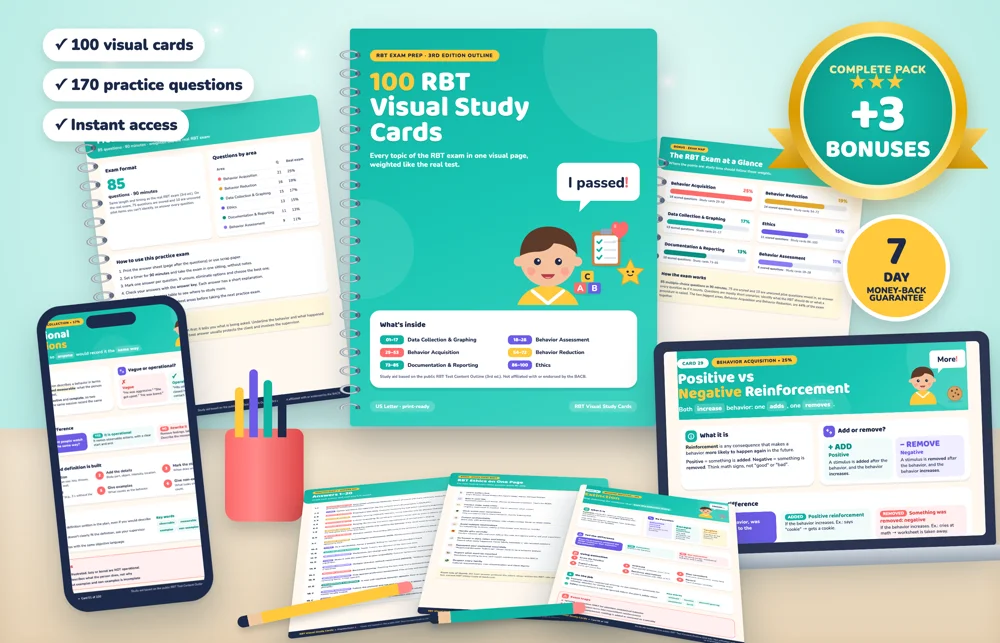
100 study cards built on the RBT Test Content Outline (3rd ed.): what each concept is, how to tell it apart, real session examples and the exam traps that catch most candidates.

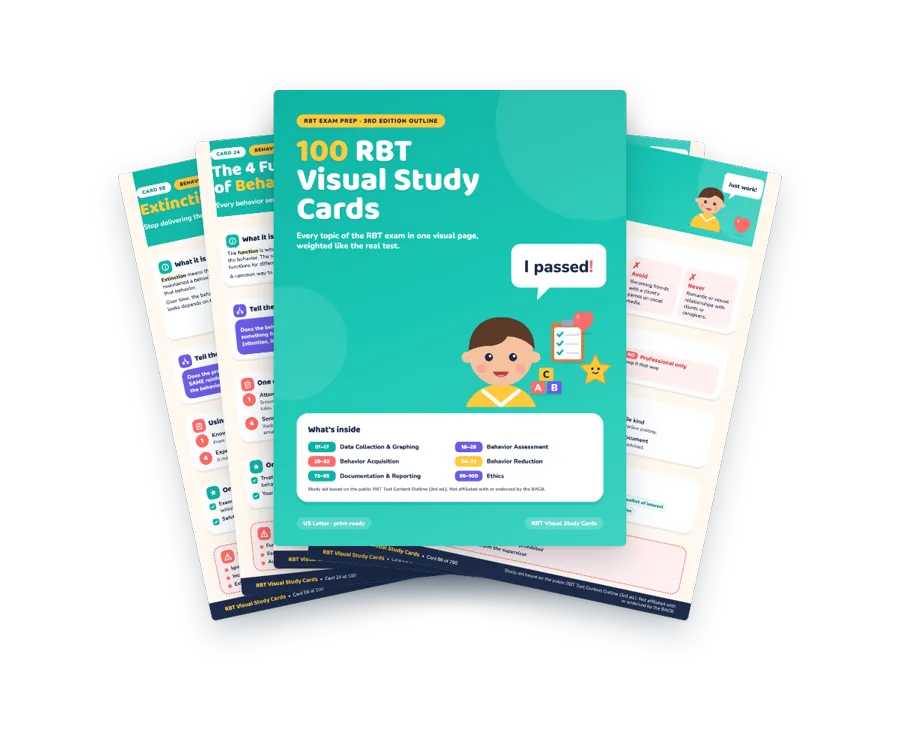
100 RBT Visual Study Cards
  • All 6 exam areas, weighted like the real test
  • "Tell the difference" box on every card
  • PDF, instant access, print or study on screen
GET THE 100 CARDSfrom $17.90 · one-time payment

🔒 Secure checkout · 7-day money-back guarantee
Your exam is coming up. Now what?

Around 1 in 4 first-time candidates don't pass the RBT exam. Most of them studied, just not the right way.

📚

Too much to read

Long manuals and scattered notes make it hard to see what actually matters for the exam.

🔀

Everything looks alike

DRA or DRO? Mand or tact? Negative reinforcement or punishment? The exam is built on these differences.

🧠

Definitions aren't enough

The exam asks what an RBT should DO in a scenario. Memorized flashcards don't train that.

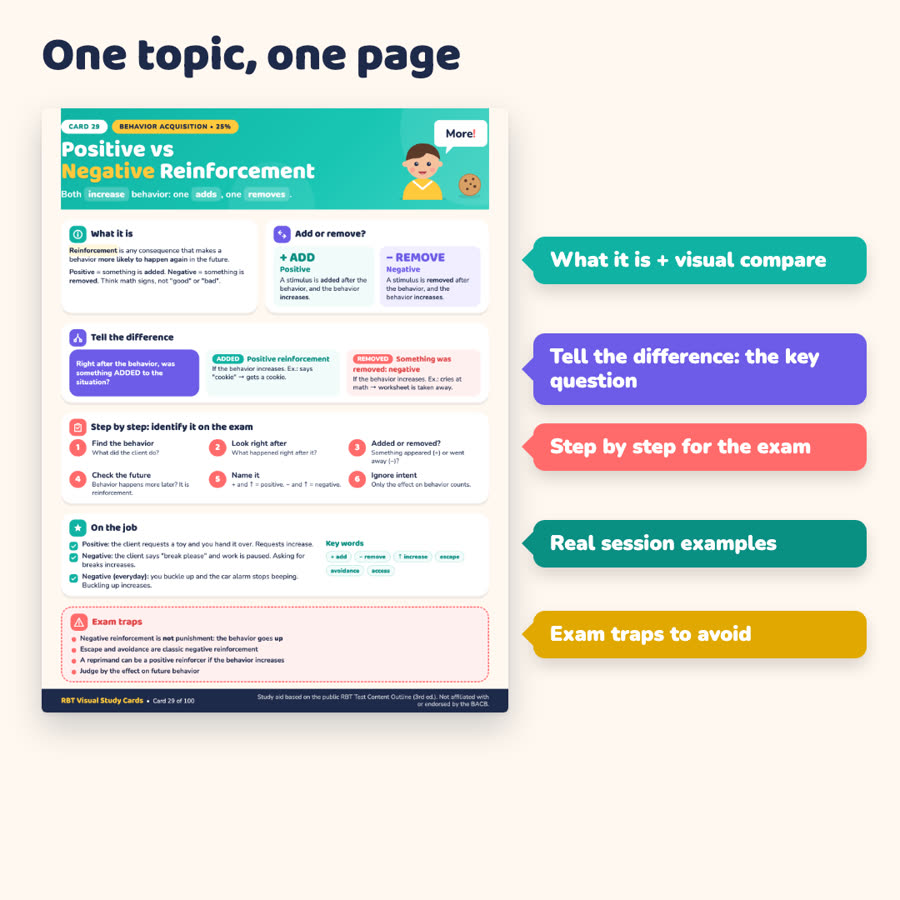
The cards fix this with one simple format: one topic per page, with the difference that the exam tests and the trap to avoid.

What is inside each card

What's on every card

Every card follows the same structure, so you always know where to look.

  1. What it isA clear definition with a visual comparison.
  2. Tell the differenceThe one question that tells similar concepts apart.
  3. Step by stepHow to identify or apply it in an exam scenario.
  4. On the jobReal session examples and key words.
  5. Exam trapsThe mistakes that cost candidates points.

All 100 cards, by exam area

The number of cards in each area follows its weight on the real exam. Tap an area to see every topic.

01–17Data Collection & Graphing18–28Behavior Assessment29–53Behavior Acquisition54–72Behavior Reduction73–85Documentation & Reporting86–100Ethics
01–17Data Collection & Graphing17 cards
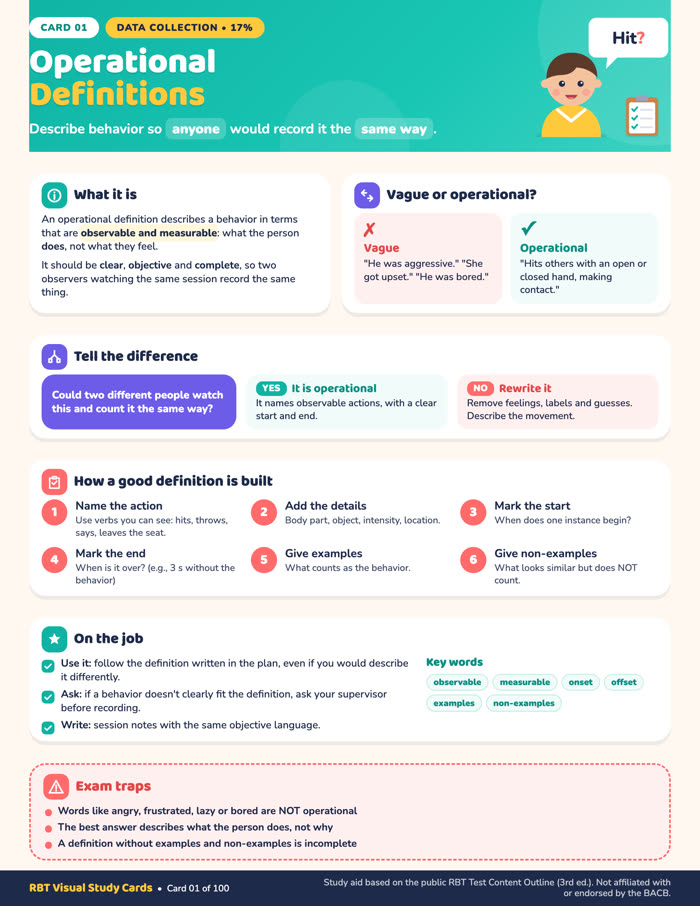
  1. 01Operational Definitions
  2. 02Frequency and Rate
  3. 03Duration
  4. 04Latency
  5. 05Inter-Response Time (IRT)
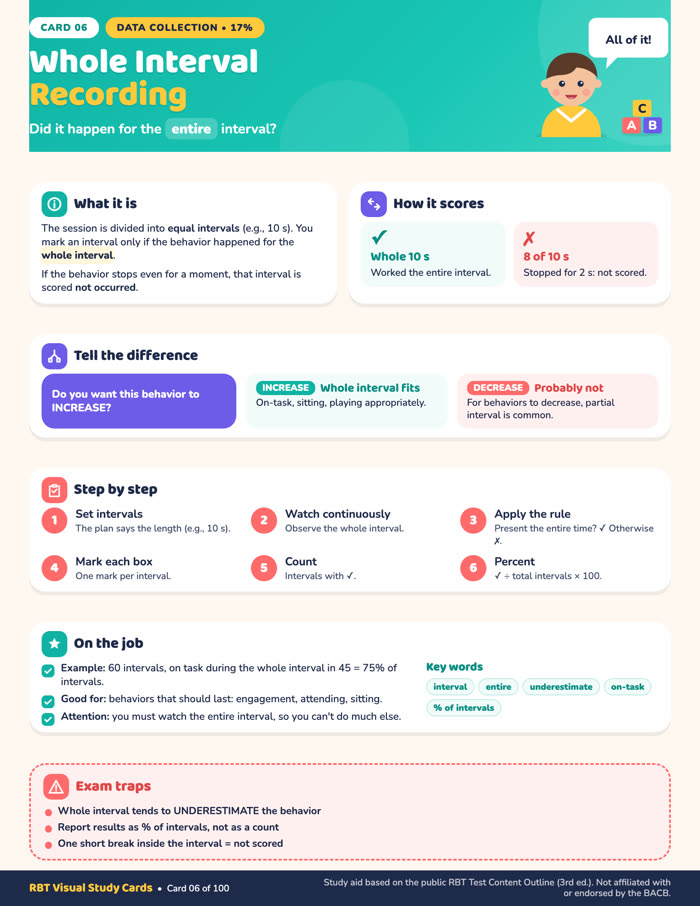
  6. 06Whole Interval Recording
  7. 07Partial Interval Recording
  8. 08Momentary Time Sampling
  9. 09Which Method Do I Use?
  10. 10Permanent Product
  11. 11Trial-by-Trial Data and % Correct
  12. 12Recording Prompt Levels
  13. 13ABC Data Recording
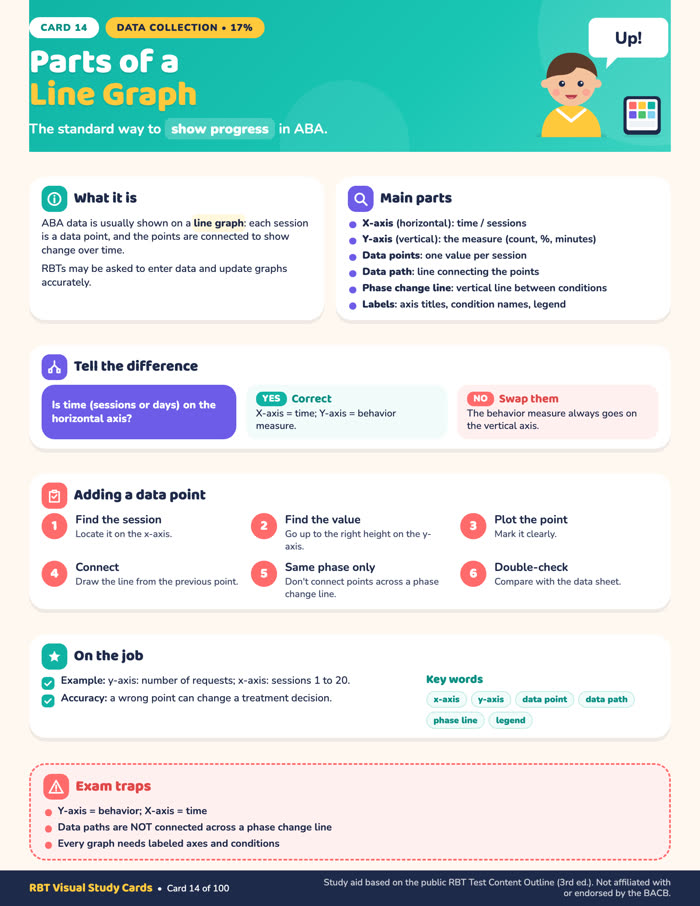
  14. 14Parts of a Line Graph
  15. 15Level, Trend and Variability
  16. 16Phase Change Lines and Conditions
  17. 17Accurate Data and Corrections
18–28Behavior Assessment11 cards
  1. 18Preference Assessments
  2. 19Free Operant Preference
  3. 20Single Stimulus Assessment
  4. 21Paired Stimulus Assessment
  5. 22MSWO and MSW
  6. 23Functional Behavior Assessment
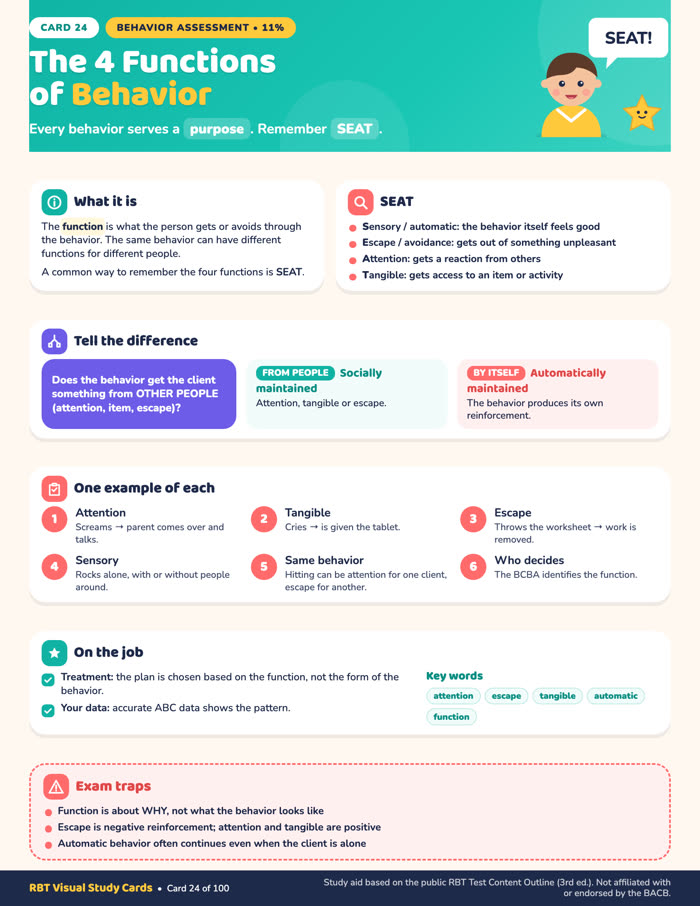
  7. 24The 4 Functions of Behavior
  8. 25Antecedent, Behavior, Consequence
  9. 26Indirect vs Direct Assessment
  10. 27Assisting with Skill Assessments
  11. 28Describing Behavior Objectively
29–53Behavior Acquisition25 cards
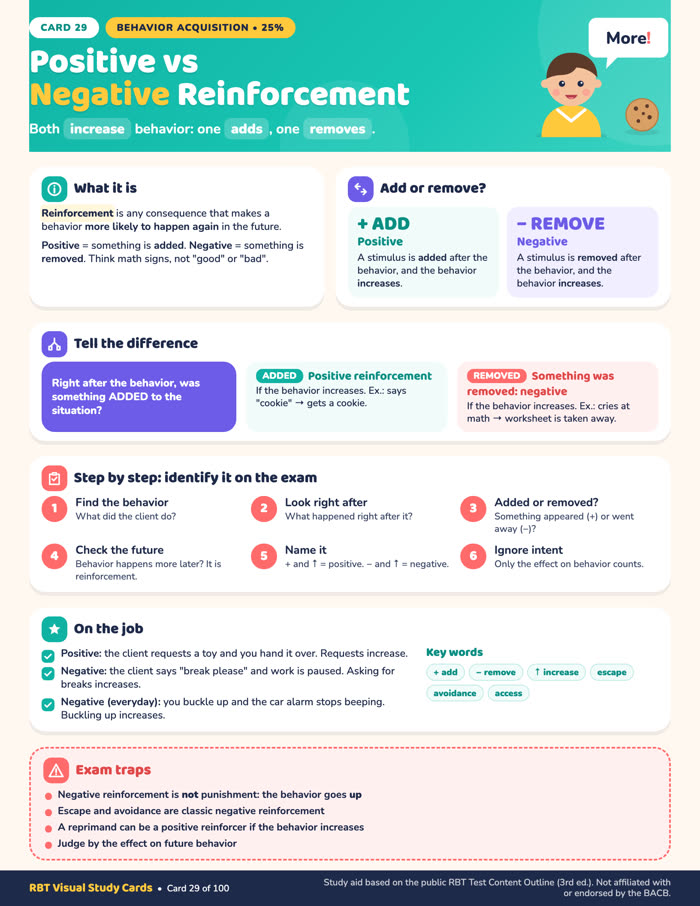
  1. 29Positive vs Negative Reinforcement
  2. 30Reinforcement vs Punishment
  3. 31Unconditioned vs Conditioned Reinforcers
  4. 32Continuous vs Intermittent
  5. 33FR, VR, FI, VI Schedules
  6. 34Token Economies
  7. 35Discrete Trial Training (DTT)
  8. 36Naturalistic Teaching (NET)
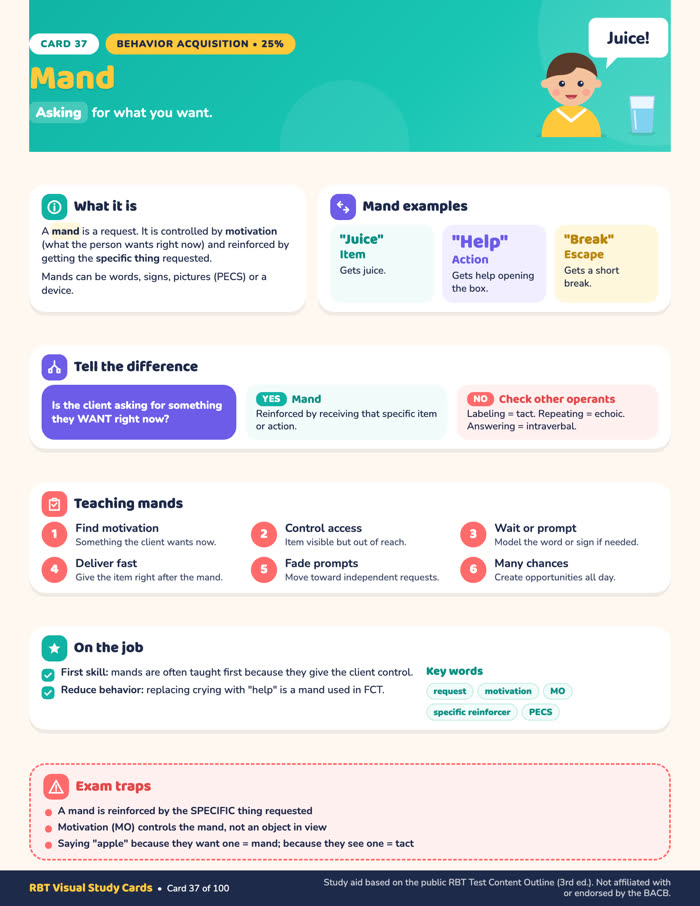
  9. 37Mand
  10. 38Tact
  11. 39Echoic
  12. 40Intraverbal
  13. 41Listener Responding
  14. 42Types of Prompts
  15. 43Most-to-Least Prompting
  16. 44Least-to-Most Prompting
  17. 45Prompt Fading and Errorless Teaching
  18. 46Shaping
  19. 47Task Analysis
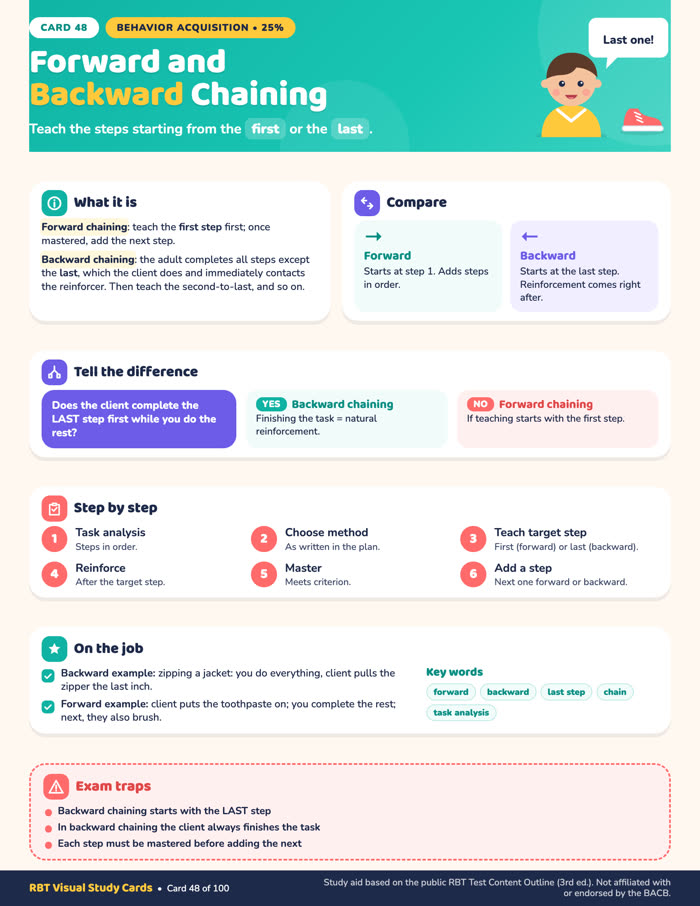
  20. 48Forward and Backward Chaining
  21. 49Total Task Chaining
  22. 50Discrimination Training
  23. 51Generalization
  24. 52Maintenance
  25. 53Motivating Operations
54–72Behavior Reduction19 cards
  1. 54Behavior Intervention Plans (BIP)
  2. 55Antecedent Interventions
  3. 56Noncontingent Reinforcement
  4. 57High-Probability Request Sequence
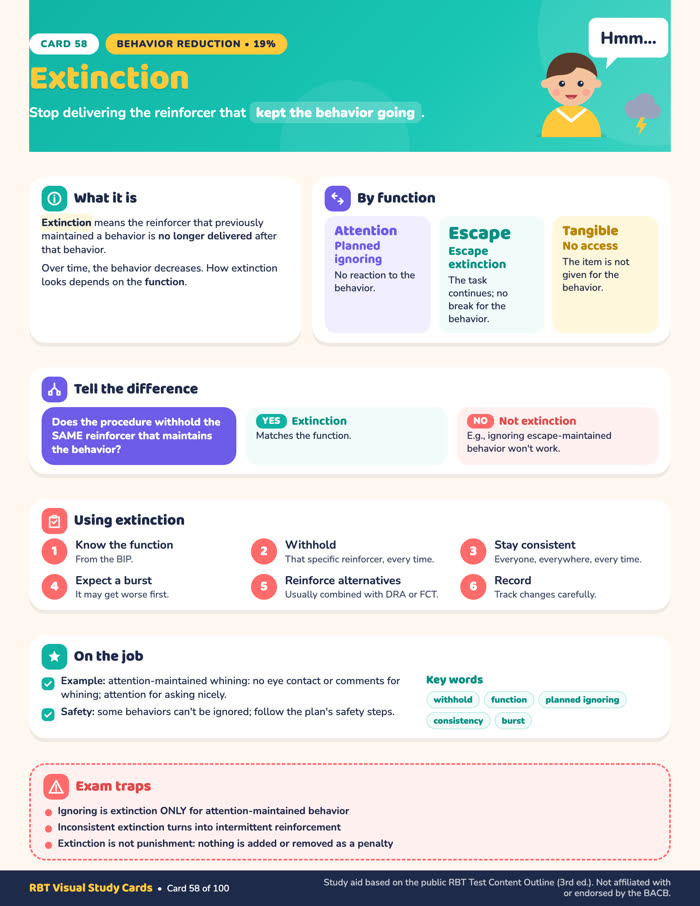
  5. 58Extinction
  6. 59Extinction Burst
  7. 60Spontaneous Recovery
  8. 61DRA
  9. 62DRO
  10. 63DRI
  11. 64DRL
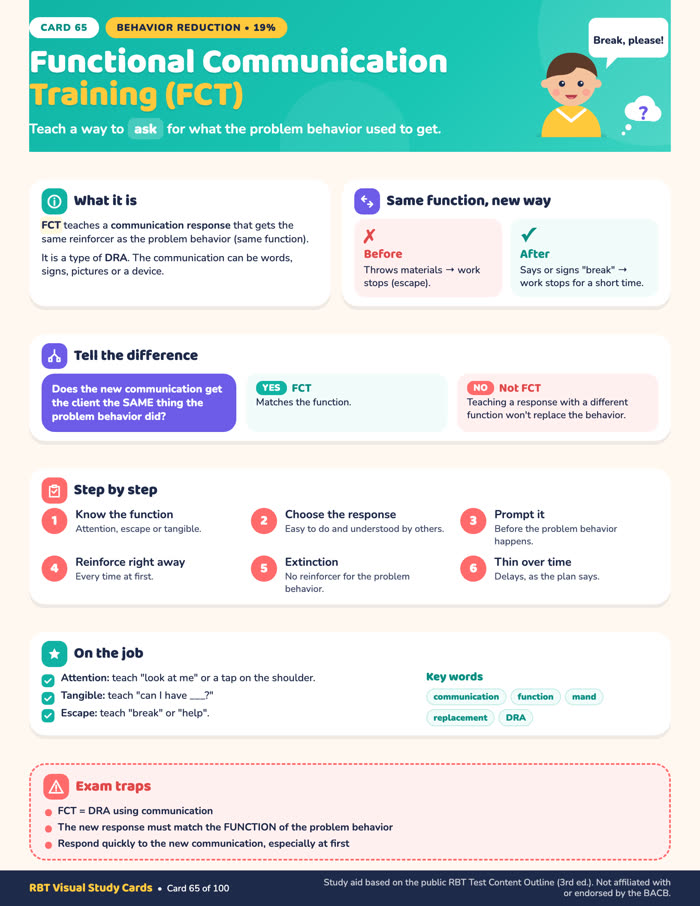
  12. 65Functional Communication Training (FCT)
  13. 66Positive vs Negative Punishment
  14. 67Response Cost
  15. 68Time-Out from Reinforcement
  16. 69Escape-Maintained Behavior
  17. 70Attention-Maintained Behavior
  18. 71Automatically Maintained Behavior
  19. 72Crisis and Emergency Procedures
73–85Documentation & Reporting13 cards
  1. 73Session Notes: Why They Matter
  2. 74What Goes in a Session Note
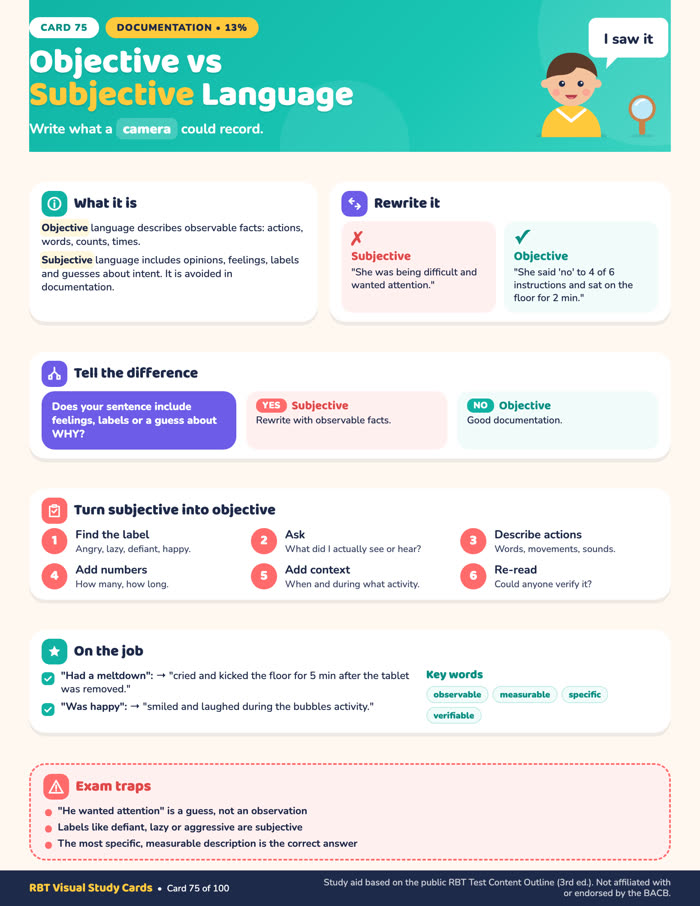
  3. 75Objective vs Subjective Language
  4. 76When to Contact Your Supervisor
  5. 77Variables That Affect the Client
  6. 78Incident Reports
  7. 79Mandated Reporting
  8. 80Confidentiality in Documentation
  9. 81Storing and Transporting Data Securely
  10. 82Talking with Caregivers
  11. 83Supervision Requirements
  12. 84Seeking Clinical Direction
  13. 85Timely Documentation and Corrections
86–100Ethics15 cards
  1. 86The RBT Ethics Code at a Glance
  2. 87Scope of Practice: What an RBT Doesn't Do
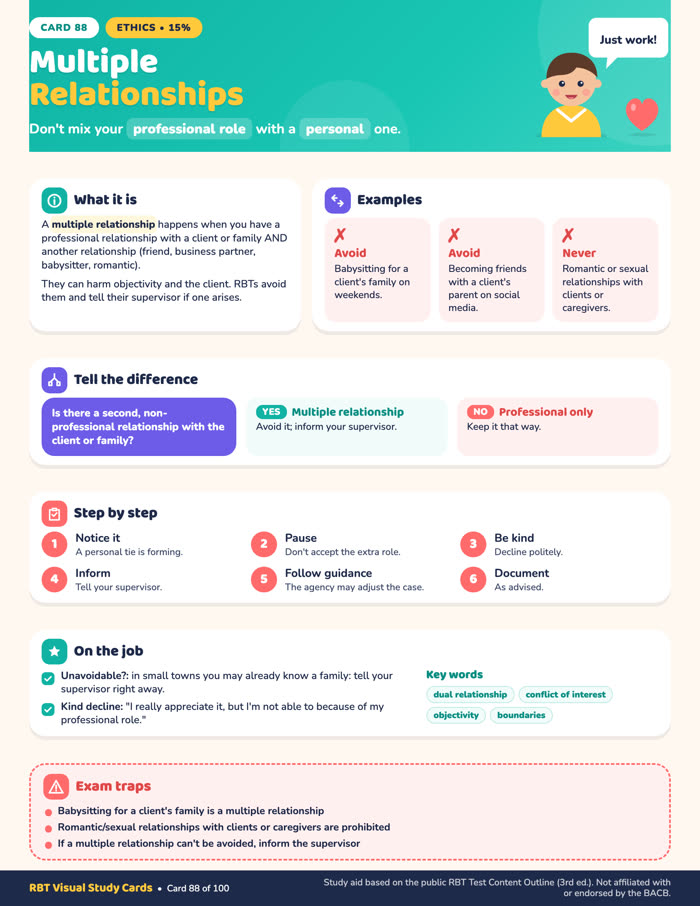
  3. 88Multiple Relationships
  4. 89Gifts
  5. 90Social Media and Photos
  6. 91Confidentiality
  7. 92Professional Boundaries
  8. 93Client Dignity
  9. 94Responding to Unethical Requests
  10. 95Self-Reporting to the BACB
  11. 96Cultural Responsiveness
  12. 97Representing Your Credential Correctly
  13. 98Working Within Your Competence
  14. 99Accurate Billing and Timesheets
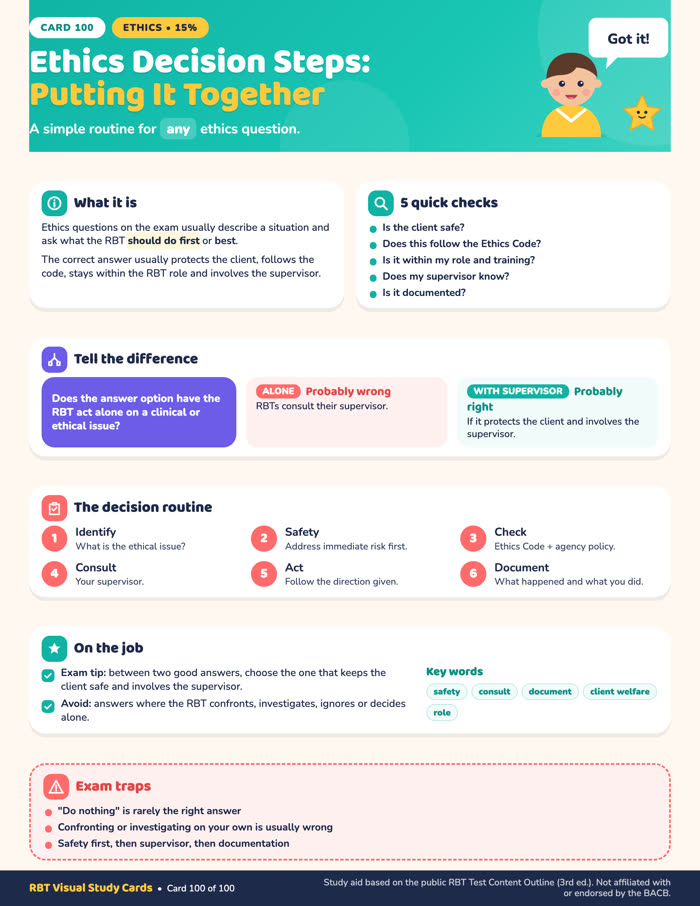
  15. 100Ethics Decision Steps: Putting It Together

Look inside the cards

Swipe to see more →

Card 01Card 06Card 14Card 24Card 29Card 37Card 48Card 58Card 65Card 75Card 88Card 100

Original illustrations, color-coded areas and large, easy-to-read text.

Print them and build your study binder

US Letter format, designed for printing. Study on your phone, tablet or on paper at your desk.

  • Numbered 1 to 100, easy to find
  • Print only what you need, or all of it
  • No subscription: the file is yours
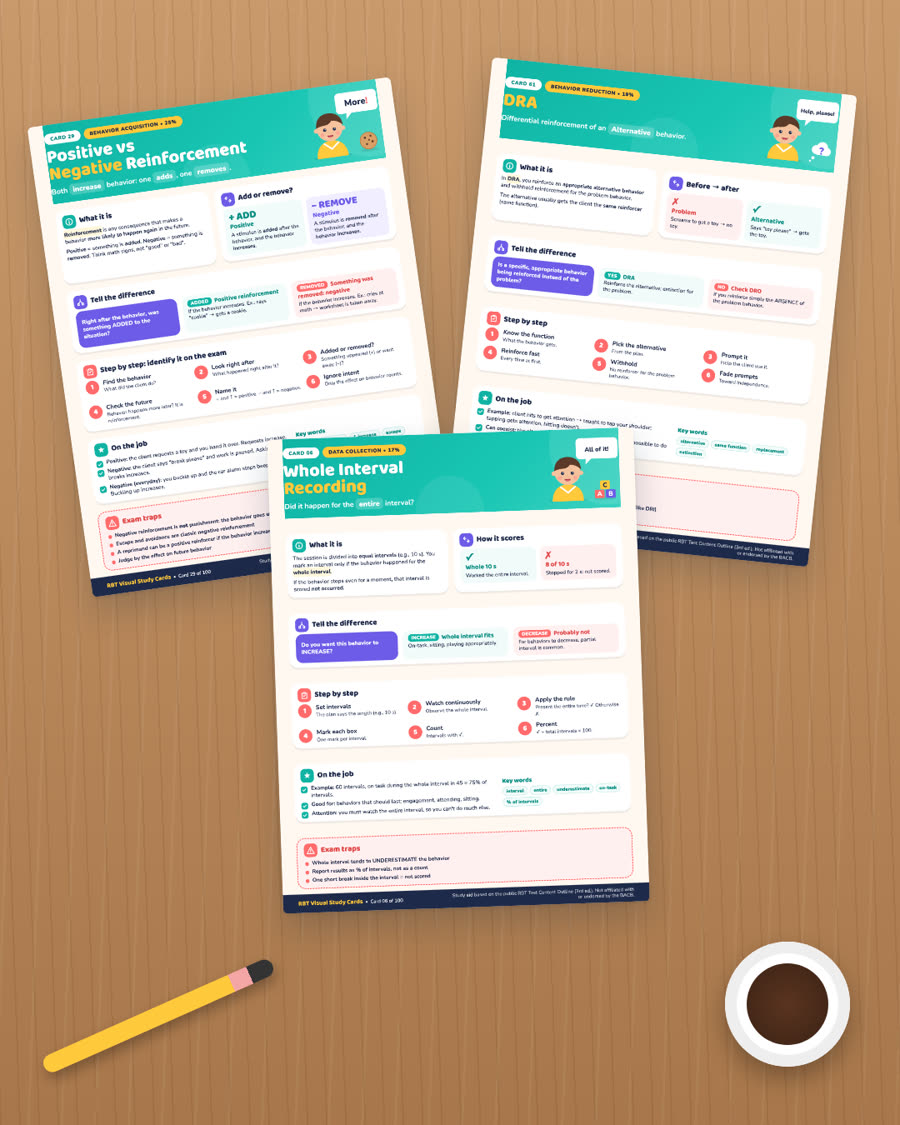
Printed cards on a desk

Complete Pack bonuses

Practice like the real exam and study with a plan, in the same visual style.

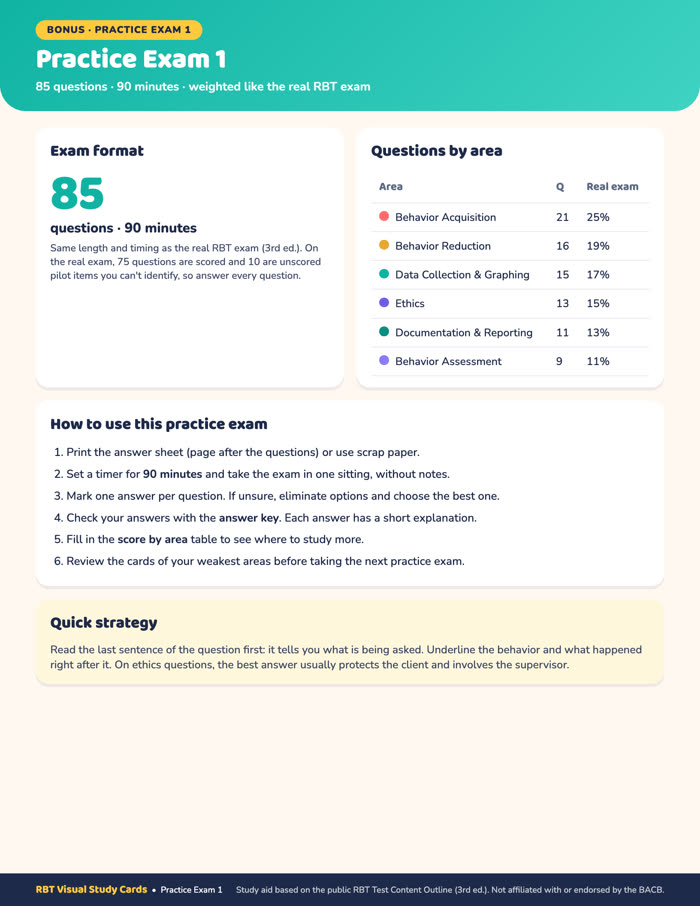
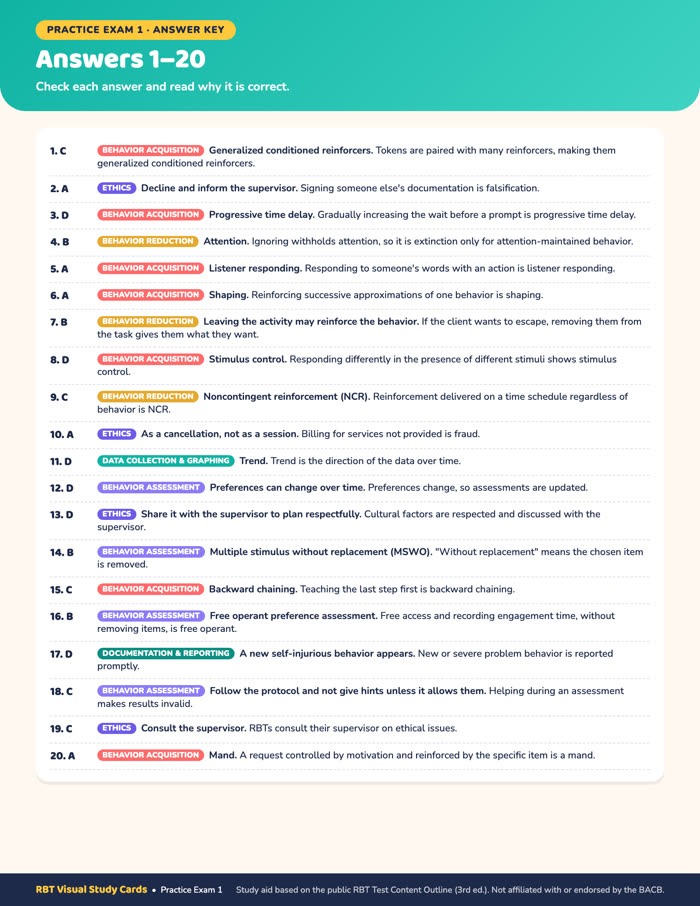
Practice exams2 full practice exams85 questions each, 90 minutes
Answer keysExplained answer keyswhy each answer is correct
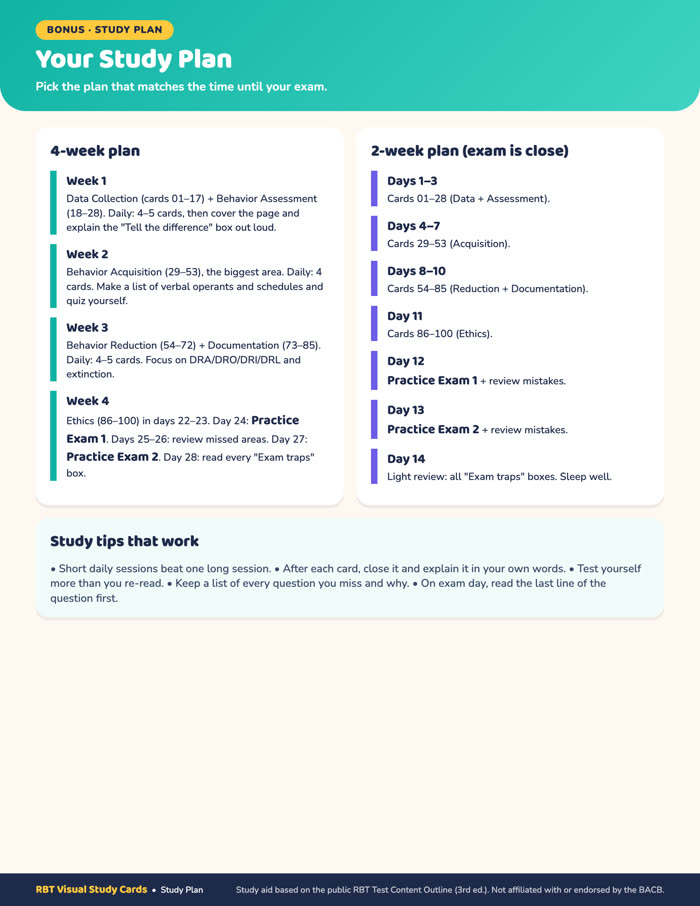
Study plans2- and 4-week study plansday by day until exam day
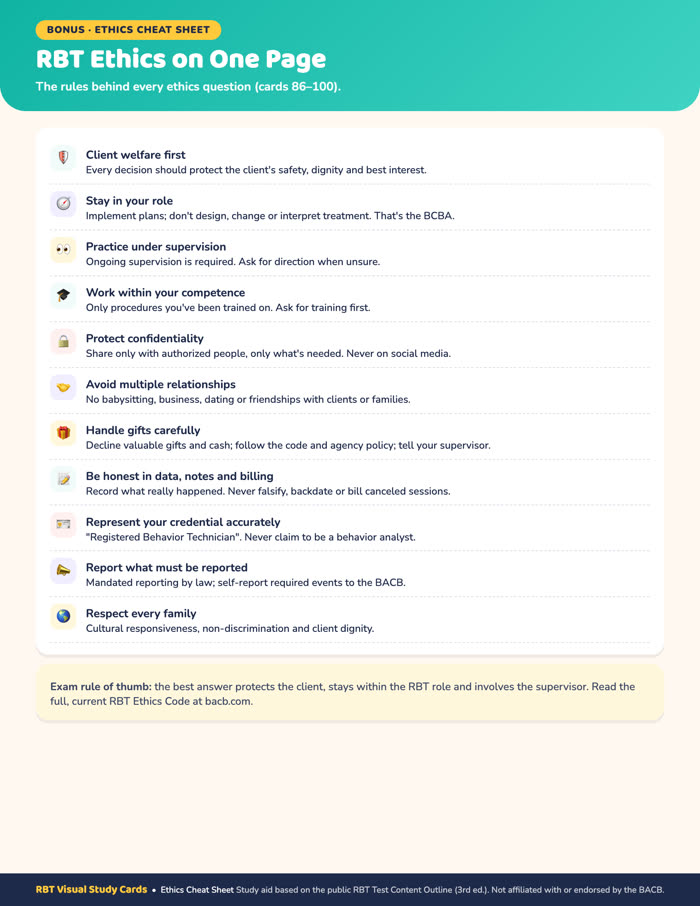
Ethics cheat sheetEthics cheat sheet + glossaryexam map and 72 key terms

Choose your plan

One-time payment. Instant access to the PDFs after purchase.

Basic

$17.90

one-time payment

  • 100 RBT Visual Study Cards (PDF)
  • All 6 exam areas
  • 2 full practice exams (170 questions)
  • Explained answer keys
  • 2- and 4-week study plans
  • Ethics cheat sheet, exam map and glossary
GET THE BASIC
MOST POPULAR

Complete Pack

Complete Pack: 100 cards + practice exams + toolkit
$27.90

one-time payment · just $10 more

  • 100 RBT Visual Study Cards (PDF)
  • All 6 exam areas
  • 2 full practice exams (170 questions)
  • Explained answer keys
  • 2- and 4-week study plans
  • Ethics cheat sheet, exam map and glossary
GET THE COMPLETE PACK
7DAYS

7-day money-back guarantee
If the material isn't what you expected, request a refund within 7 days of purchase and you get 100% of your money back.

Frequently asked questions

How do I get the material?

Right after your payment is confirmed, you receive access to the PDFs at the email you used to purchase.

Is it physical or digital?

Digital (PDF). Study on any screen or print at home or at a print shop, as many times as you like.

Is it updated for the new RBT exam?

Yes. The cards and practice exams are based on the RBT Test Content Outline (3rd ed.), used for exams from January 1, 2026.

Is there a subscription?

No. It's a one-time payment and the files are yours.

Who is it for?

RBT candidates preparing for the exam, and RBTs who want a quick visual review of the main concepts.

Is this official BACB material?

No. It is an independent study aid based on the public RBT Test Content Outline. It is not affiliated with or endorsed by the BACB. Always check bacb.com for official requirements.

What's the difference between the plans?

The Basic plan includes the 100 cards. The Complete Pack adds 2 full practice exams with explained answer keys, study plans, an ethics cheat sheet, an exam map and a glossary.

Study smarter for your RBT exam

100 visual cards for less than the cost of one exam retake fee.

SEE THE PLANS